
Rez Oscillator
Audio Generators
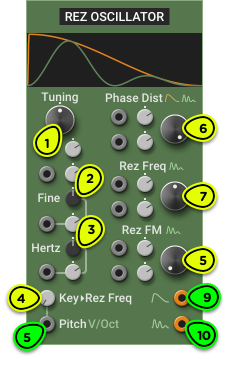
- Tuning Knob Sets the oscillator frequency when the Pitch input is at 0V. Double-click for middle C.
- Fine Knob ±1 semitone adjustment around tuning frequency.
- Hertz Knob ±5 Hz adjustment around tuning frequency.
- Key▸Rez Freq Knob Controls the Rez Freq key tracking.
- Pitch Input Calibrated for 1V/octave pitch signals.
- Phase Dist Knob Gradually morphs the waveform of the phase distortion oscillator from a sine wave to a smooth sawtooth.
- Rez Freq Knob Sets the resonant peak frequency of the Rez output.
- Rez FM Knob Gradually adds odd and then even harmonics to the resonant peak of the Rez output.
- Phase Dist Output Phase distorted oscillator output, affected only by the Phase Dist knob.
- Rez Output Simulated resonant filter output, affected by the Phase Dist, Rez Freq and Rez FM knobs.
Overview ⚓︎
The 1980s were an era of innovation in oscillator design, often using digital chips to generate and control waveforms. These digitally controlled oscillators (DCOs) used a variety of techniques to either emulate existing analog oscillators or create sounds that had never been heard before.
The Rez Oscillator is inspired by a clever technique developed in the mid 1980s to simulate resonant low-pass filter sweeps without actually needing a low-pass filter in the synth. Our take on this idea combines phase distortion, hard sync, frequency modulation (FM) and amplitude modulation (AM) in a versatile package with three simple but powerful sound-shaping controls.
In Depth ⚓︎
Tuning ⚓︎
Tuning is controlled by the main Tuning knob, the Fine and Hertz knobs, their respective modulation inputs, and the Pitch input. See Oscillator Tuning for more information.
Theory of Operation ⚓︎
The module contains three oscillator cores, all based on an inverted cosine wave:
The phase distortion oscillator is tuned by the module’s main tuning controls, and the Phase Dist knob controls its waveshape. It produces sound on the Phase Dist output (the topmost jack at the bottom‑right of the module). Its waveform is represented in orange on the built-in oscilloscope.
The rez oscillator is tuned with the Rez Freq knob. By default it doesn’t follow the Pitch input, but this can be adjusted with the Key▸Rez (key follow) knob.
An internal FM oscillator applies FM to the rez oscillator when using the Rez FM knob.
The sound on the Rez output (bottom-right output jack), represented in green on the built-in oscilloscope, is produced by a complex combination of the three oscillators:
The internal FM oscillator applies frequency modulation to the rez oscillator, according to the position of the Rez FM knob.
When the phase distortion oscillator reaches its lowest point, the rez oscillator is reset (hard sync).
The signal of the rez oscillator is multiplied by the phase distortion oscillator (amplitude modulation) to remove the falling edge caused by hard sync.
See this illustration:

Controls ⚓︎
Phase Dist
This knob controls the amount of phase distortion applied to the phase distortion oscillator. It affects both outputs.
When the knob is fully counterclockwise, the phase distortion oscillator produces a sine wave. When fully clockwise, it produces a sawtooth-like waveshape.
When listening to the Rez output, try the highest Phase Dist setting, the lowest Rez FM setting, and then turn the Rez Freq knob or modulate it with an envelope or an LFO. You should hear a rather convincing simulation of a resonant low-pass filter sweeping over a sawtooth wave. Adding a bit of Rez FM can simulate a distorted low-pass filter, perfect for producing acid bass sounds.
Rez Freq
This knob controls the frequency of the rez oscillator, and has no effect on the Phase Dist output. Its effect is similar to controlling the cutoff frequency of a resonant low-pass filter.
This does not affect the perceived pitch of the Rez output. Since the rez oscillator is hard-synced to the phase distortion oscillator, the Rez output always follows the pitch of the Phase Dist output.
Modulating the Rez Freq with an envelope or an LFO can result in sounds similar to filter sweeps or hard sync on the Rez output, depending on the Phase Dist and Rez FM settings.
Rez FM
This knob controls the waveform of the rez oscillator. More FM can make Rez Freq sweeps sound less like filter sweeps and more like hard sync.
See the Rez FM Algorithm section below for more information.
This knob has no effect on the Phase Dist output.
Key▸Rez Freq
When fully counterclockwise, the rez oscillator frequency is independent of the main oscillator tuning. This behaviour makes the Rez Freq control similar to the Cutoff knob of a low-pass filter, which is not affected by the frequency of the filtered oscillator signal.
When fully clockwise, the rez oscillator frequency will follow the signal on the Pitch input. The Rez Freq knob represents the rez oscillator frequency when the Pitch input is at 0V (middle C).
By setting Key▸Rez at 100%, the Rez Oscillator can be used to create a near infinite number of static waveforms for leads with the Rez output. Disconnect all modulations from Phase Dist, Rez Freq and Rez FM, and try different positions for these three knobs. Start with Rez Freq somewhere between 200 Hz and a few kilohertz for best results.
Technical Notes ⚓︎
Bandlimiting
Although Multiphonics is not limited by CPU power or memory like digital oscillators in 1980s synths, we chose to create an algorithm that could have worked on a synth from that era. For that reason, we chose not to use oversampling or modern bandlimiting techniques. Instead, to mitigate aliasing in the upper registers, we gradually reduce the amount of phase distortion and FM when the frequency of the phase distortion oscillator or the rez oscillator rises above 500 Hz. At 8000 Hz, all modulation is disabled, so don’t be surprised if the knobs seem to have little effect when playing very high notes.
DC Component
In most cases, the outputs oscillate in a range from -5V to +5V, like other oscillators in Multiphonics. However, because the Rez waveform is not perfectly symmetrical, the Rez output may include a negative DC offset. This offset can become quite large when Rez Freq is low; in some cases, the signal can remain entirely below 0V. This is usually not a problem, but depending on how you use the output signal, you may want to remove the DC component by processing it with a µHP filter set to a cutoff of around 10 Hz.
Rez FM Algorithm
Frequency modulation (or more accurately phase modulation, as in most digital FM synths from the 1980s) is applied to the rez oscillator in two stages.
When fully counterclockwise (0%), no modulation is applied and the rez oscillator is a sine wave.
Turning the knob clockwise from 0% to 50% engages the first modulation stage, using the internal FM oscillator to modulate the rez oscillator at a 2:1 ratio. This results in a smooth square waveform that adds odd harmonics to the sound.
Turning the knob clockwise from 50% to 100% engages the second modulation stage: the first stage fades out and is replaced by an FM feedback loop. The rez oscillator is modulated by its own output, turning the waveform into a smooth sawtooth that has both odd and even harmonics.