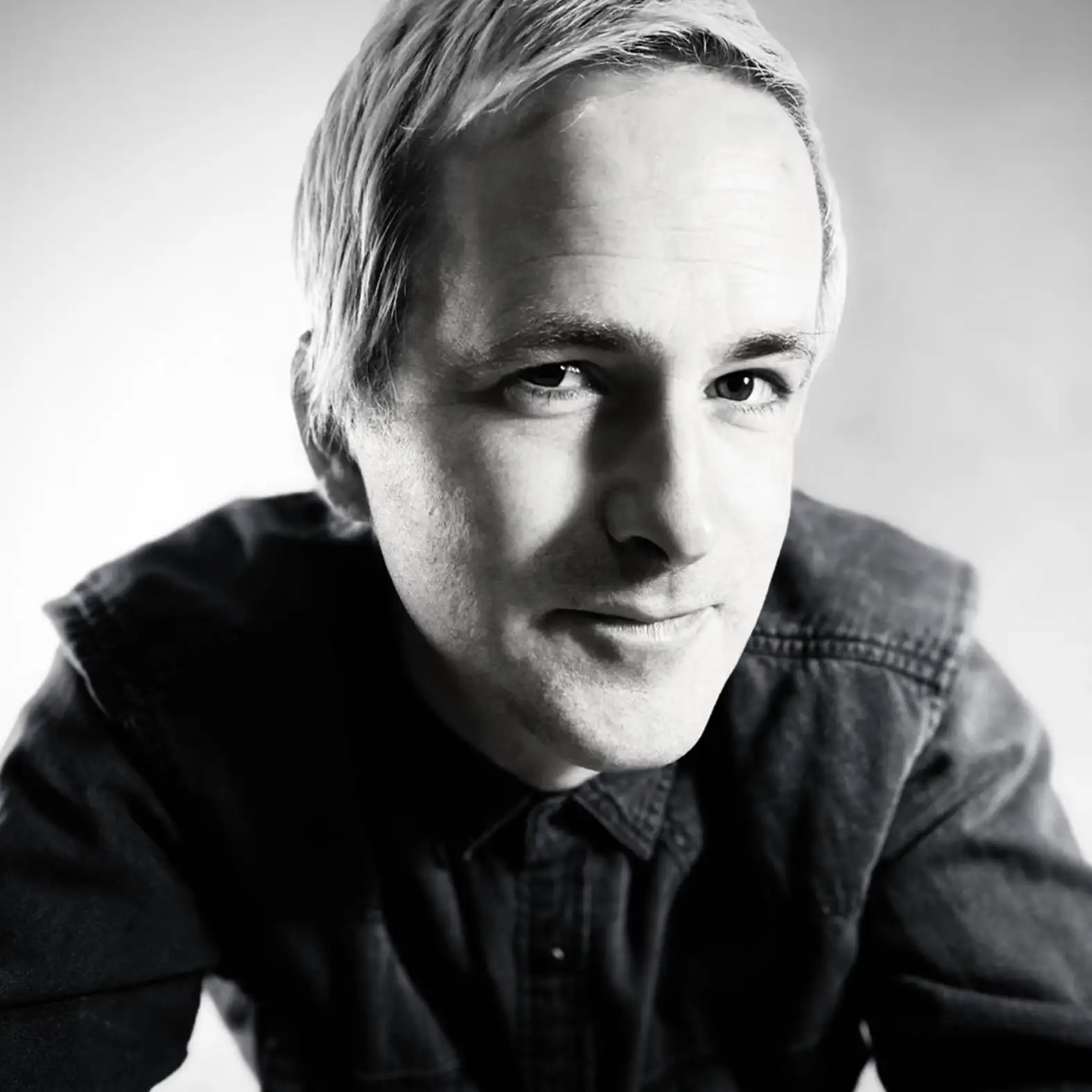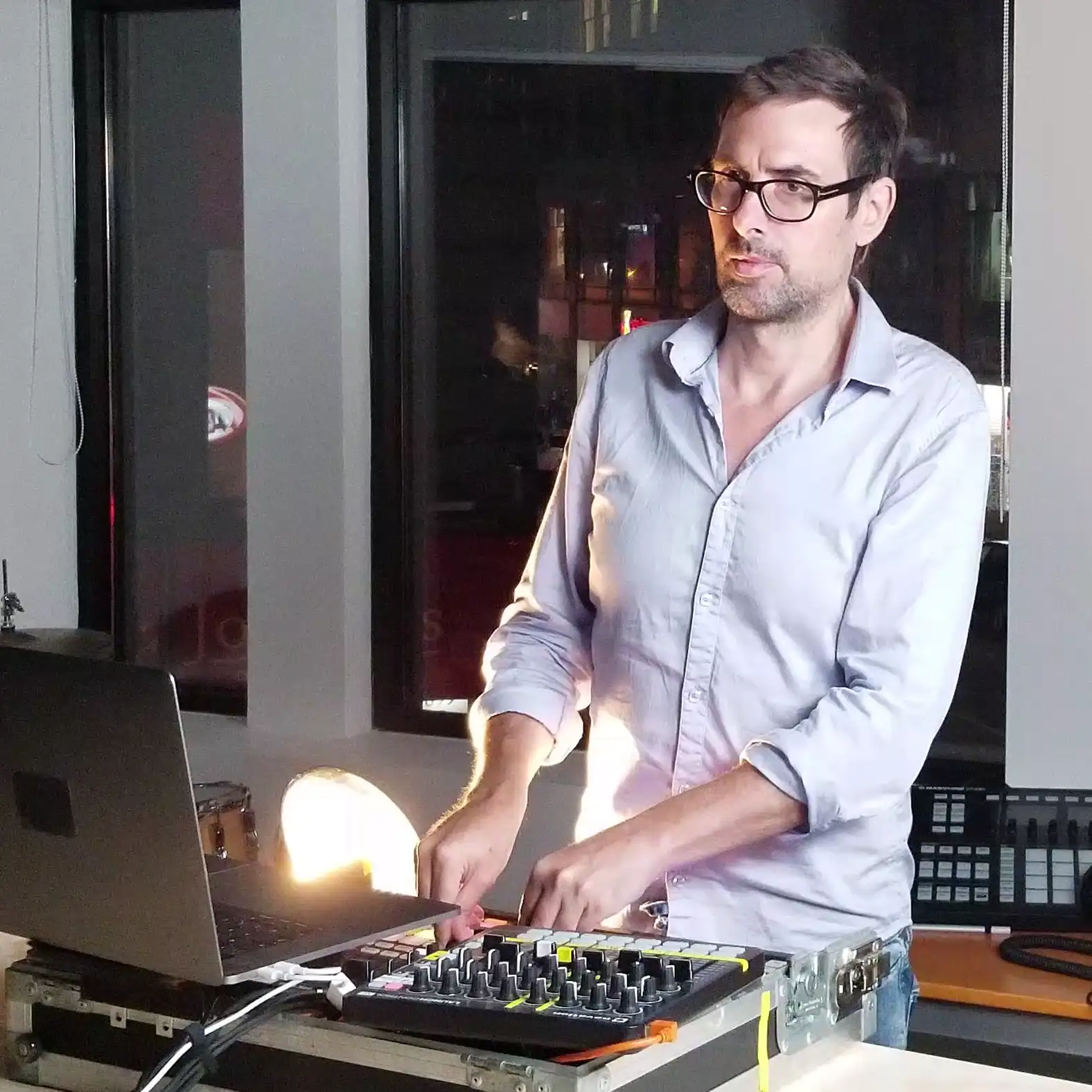
Scanner a.k.a Robin Rimbaud

by Tobias c. van Veen

Creating innovative and intriguing work since the ‘80s, Robin Rimbaud is an audio-artist who has managed to engage with rhythm in a critical yet creative fashion. Like Dj Spooky, Scanner possesses the flexibility to understand and compose different styles and moods of music, yet the daring to produce work that can question these ‘preset’ limitations. The focus and format of his productions (not to mention his touring schedule) are always on the move between film soundtrack and art gallery, club and dance hall. His audio works range from the calm reflections of field recordings and meditative use of tape-loops, ambient albums that are now landmarks in the genre, to composed electronic soundscapes for film and ballet, while at the other end of the spectrum, quirky house music (as Scannerfunk) balances his sound installations.

Rimbaud’s use of ‘found sound’ conversations dubbed him a ‘telephone terrorist’ in the early-mid 90s’ when the world was still using easily eavesdroppable analogue cellphones. Riding the wave of the UK electronic music explosion, Scanner’s esoteric and slightly academic work began to reach the ears and eyes of club audiences, linking techno with ambience and the pervading influence of surveillance technology, cementing a link between the experimental and groove-oriented scenes that earned praise from both quarters (including memorable praise from infamous avant-garde composer Karlheinz Stockhausen, who said: “He is very experimental because he is searching in a realm of sound which is not usually used for music... he has a good sense of atmosphere.”).

Along with creating work for dance, film, CD and installation, Rimbaud runs his own label—Sulphur Records—which has released curious work by Stephen Vitiello and Michael Wells, among others. The two notable releases in the growing but select catalogue include the Needle in the Groove collaboration between UK cyberpunk author Jeff Noon (of Vurt fame) and famed avant-gardist (and writer/critic) David Toop, as well as Scanner’s own collaboration with DJ Spooky, The Quick and the Dead. See www.sulphurrecords.co.uk for the full discography.

As of October 2003, Rimbaud’s most fascinating—yet, profound—project to date is a sound-piece for the Hôpital Raymond Poincare in Paris which treats road injury victims. According to Robin, in his own words, “The chief pathologist Doctor Michel Durigon decided it was time to create a Salle des Departs, a place where families and friends could come to say goodbye to their loved ones without, as he says, ‘having to suffer sickly background music and a red carpet.’ The result was a commission for a groundbreaking piece of art: a room designed by Italian artist Ettore Spaletti, and later a musical soundscape which I was invited to contribute, alongside American composer David Lang of Bang on a Can.”

Scanner himself keeps the world updated on his travels and new audio explorations at www.scannerdot.com.

A Few Words with Scanner

How did you get into the experimental spectrums of music--the sound installations, scores, radio-art and so forth? How did you find yourself drawn (back?) to beat-driven music?

Goodness, I wish I could answer this simply. If I drop a handful of dust into the air, it will spill to countless places, many of which you cannot control or anticipate. When I began making electronic music some years ago, my work began to appear on compilations, remixes, radio shows, etc and in their way they created the pattern for me, without my choice mostly!

I've always been interested in beat driven music, in fact at present find some of the most inspiring and inventive use of sound in contemporary urban/r & b productions. I found that beats offer the chance of presenting often very experimental items in a tighter framework that can be very seductive to the listener.

How do you view the often uncrossable divide between experimental and rhythmic composers—a divide that you have successfully traversed, and often?

Well, it's obviously not 'uncrossable' if somehow I've managed to do it but I can't explain the success of it. In fact I can make few claims about my productions at all, most that I've tried my utmost to create works that might inspire, stimulate, move people in the right context. I believe obviously that boundaries should not affect how or where one works. Art for me has never been a 'thing', an object oriented discipline but more of a process, and as such any frames that people have a tendency to put work in immediately produces limitations, as the labeling of works has taught us.

When did you start working with computers? Software? How do you incorporate it into your studio set-up?

I bought an Atari 1040 early on with a Yamaha keyboard. Most of my early records were almost entirely created using a Tascam four track tape recorder and a small echo unit that would allow me to sample up to around 15 seconds of sound, but with no ability to edit these loops. I used Cubase early on as it seemed to be the most capable of sequencers. Nowadays like many others this has developed into a smaller, mobile unit of a laptop, software synths, Logic Audio, etc.

What do you use the Tassman / Lounge Lizard for, in your set-up?

I've been using Tassman largely as a rhythm box in a plug in context within Logic and creating some amazing sounding structures with it, especially Midi-ed up so I can constantly alter the parts live in situ. Lounge Lizare is offering a very fine alternative to a real keyboard in my studio, its crystal clear sound working beautifully in a work I'm currently writing for a film soundtrack.

What would you like to see in the Tassman / Lounge Lizard?

Well, I haven't exhausted what it has to offer at present so this is difficult to answer. Being on the road right now I could be mistaken but in fact is there a place for users to upload their settings and exchange them? I love being able to do this with Reaktor.

Is there a living composer whom you have yet to work with you'd give your left arm to collaborate with? Dead?

Gosh, there are countless people I'd enjoy the experience of working with, whether it's from the popular music world - Pharell Williams, Tricky, Brian Eno, David Sylvian, Robert Ashley, Jack Dangers, Jonathon Bepler, Robert Wyatt. Dead? I think it's a little more practical to think in the present ;-)

Given the relative demise of the subcultural drive behind electronic music—rave culture, acid house, but even the techno & house cultures, jungle, chill out—do you see the future of electronic experimentation in general relying upon a meditative return to avant-garde exploration? Or is there the possibility of another generational surgence interested in pushing into social realms? I ask because, as a world-traveller, your perspective is unique, moving between gallery and club...

It's interesting to recognise the recent explosion of Rock music again, almost one senses as a return to the 'real' as the art critic Hal Foster might argue. It's as if post Sept 11, there's a desire for authenticity that for many people electronic music cannot offer, hence the global rise of The White Stripes, The Darkness and countless other artists beginning with 'The.' If anything it offers a significant place for more meditative avant garde explorations to happen elsewhere I feel. I still hear some of the most beautiful and moving electronic music in my travels, whether it's on a demo CD given to me in Istanbul, the latest Pimmon CD I found in a record store in Perth Australia or the soundtrack to an independent film. None of these address a wider techno culture, they are as much about themselves as they are anything else and yet this appeals to me.

Most people today know you as "Scanner," the alias that gained ground through your work with the cellular transmissions projects in the early '90s that mixed found-sound airwaves with ambience and occasional beats. However, today your work has to a degree returned to the aesthetics that seemed to interest you in the '80s: radio-art, composition, and aspects of musique concrète (I am thinking mainly of phonography/field recordings, tape-loops and so on). This return interests me, as it is a return to all the interests of the '80s with, for the most part, different tools (critically dissident from the various, nostalgic electro-etc attempts). I'd like to ask you how it feels to dip back into the "avant-garde" feel that permeated the '80s, in an atmosphere that has become predominantly "digital." Are artists in fact returning to ideas that were abandoned with the arrival of chill-out and rave culture, now that these subcultures have seen their relative demise? Is a sense of the radical and political elements of DIY/punk/industrial culture returning, albeit communicated and mediated with different technologies, digital and the Net?

Wow, I wish I could answer this with as much clarity as the question. I would like to think that there has thankfully always been a strong positive culture of fanzine /DIY culture, that may have gone through its ups and downs over the years but still exerts a very powerful underground force. Where once this may have clearly been recognised in magazines, record releases, etc. in the past, today it's just as valid in the form of web-blogs, websites, pirate radio, etc.

Personally speaking in recent years I began to recognise in my own work that it was essential to be true to yourself, and not try to address wider issues of recording, like marketing, the commercial potential and so on. In some ways I can see that this may seem to be a 'return to the 80s' but I believe I'm using the tools of the present to attempt to transcribe what I've always been trying to do.

A language of sound and creating is always changing with the times, one can pick up frames of reference but what's exciting and still keeps me motivated is having no idea as to what the future may bring. I try to remain as positive as possible in for what many have found to be reasonably dark times.