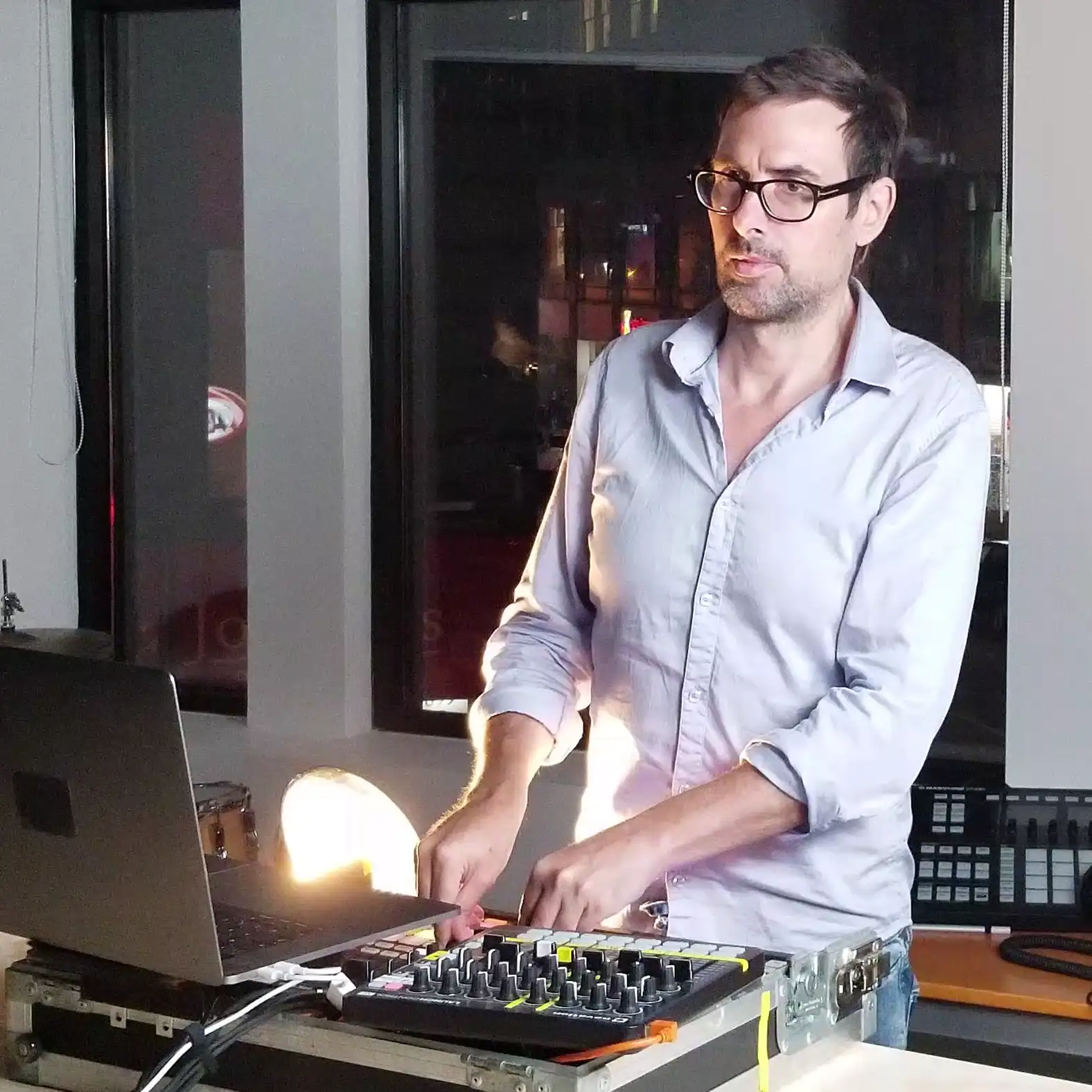
Kevin Young
Kevin has written, recorded and toured with the Juno Award-winning band Moist, the David Usher Band and a variety of other projects. As a working musician he has appeared on stage with a diverse group of artists, including Ridley Bent, Brian Byrne, Stabilo, Classic Albums Live and others. He continues to tour regularly and provides sound design and music for various broadcast and web applications, live theatre and dance. He is also a freelance writer specializing in music, tech, travel and humour for a variety of national magazines and industry trades.
A Few Words with Kevin Young
What have you been working on lately?
For most of this past year I’ve been touring on and off in support of David Usher’s record, Strange Birds. We’ve just finished up this past weekend with a show in Lake Louise, Alberta. Recently, we started pre-production for the next record, first in sessions in New York, then at my home in Toronto. Come January, the band will be heading to Montreal for a couple of weeks, taking the songs we’ve demoed in Live and working on arrangements and instrumentation.
Does touring with David Usher leave time for other projects?
Things don’t so much get finished on tour, they get started—moving fast, meeting loads of people, not to mention the whole collaborative process of getting new music up and running for the studio—it fuels a lot of ideas. It’s just not always possible to implement them between gigs in Thunder Bay and Timmins. Now, with the tour winding down, I’m hunting for new projects to take on. I wear a variety of hats; performing, writing, occasionally composing it’s an ongoing process, figuring out which hat the money is under on any given day, or month.
Our tour schedule hasn’t been constant, but it has been fairly heavy. On tour, you get into the routine of a very spread out work schedule, which is a bit counter to my normal process. Whether I’m working on music, or writing, I tend park in front of the computer and work until the job is done. On tour there are bursts of creative energy; times in sound check where everyone comes together to work on David’s new material. But, for my own work, it’s more about gathering ideas and cataloging them for later.
I remember seeing you live with Moist; you gave such an energetic performance. Can this high level of energy be translated in the studio?
In the right environment—yes—absolutely, but it isn’t always easy. One of the things a number of artists complain about is how difficult it can be to capture the energy a song had when it was first written in the studio. It’s an elusive and often subjective thing. Sometimes, we’ve found that chasing the demo isn’t worth the effort or time. Your first recording might not be the one you spent the most time on, but it might just be the definitive version, warts and all. The proper tools, an open dialogue between the band and producer are important, but the key element is capturing inspired performances, regardless of whether you’re recording in your living room or a full on studio.
I remember trying to recapture the sound and vibe of something our drummer and I had recorded using my cell phone during sound check. It was a piece he and I were recording for soundtrack and though it sounds ridiculous, we were actually chasing the crappy cell phone version to get it right. Sometimes, finding that energy again is as simple as going back and listening to early versions, no matter what the quality, so if the track starts to go off the rails during recording you have a reference to get you back on the right path.
How do plug-in instruments integrate into your studio workflow?
They’ve made it possible to actually get some work done on tour. My process is always more effective when there are limited distractions around me. I’ll find a place to sit with headphones, a small controller and just workshop sounds. In some cases, I’m purely passing time, or learning a piece of gear that I might be reviewing. In the end, when it comes down to the arrangement process, and we’re sitting in rehearsals or sessions looking for parts and sounds, I’ll have a deep well of options to draw on. Even when I’ve defaulted to hardware solutions in the past, I still used software as my research library. In every case, I like to have a large and diverse library of sounds close at hand and increasingly, I’m depending on plug-ins to generate pianos, and orchestral sounds, as well as more off the wall electro acoustic and synth patches.
Which AAS instruments do you use and in which context?
My experience with AAS over the years has been primarily with Tassman, and Lounge Lizard, and more recently, String Studio and Ultra Analog. Again, they’re my research libraries, my portable lab for finding unique new sounds. I’ve used them recently on David’s demos, and some music intended for commercial applications and I’ll be relying on them heavily for an upcoming piece commissioned for use by a new Canadian Extreme Sports site (www.extremeculturecanada.com), which is launching early 2008.
On stage, I’m running Live 6 with Sampler, String Studio, and Lounge Lizard on my Macbook. The laptop is primary my sampler, but it’s also my backup, in case any of my hardware dies mid show. AAS has been invaluable to ensuring that backup is solid. I use a fair number of Wurly and E-piano patches and string/synth layers live. While they’re not incredibly complex, they have a distinct character, and the depth of the String Studio and Lounge Lizard virtual control surfaces has allowed me to recreate them effortlessly.
What’s coming up next?
I’ve spent very little time at home since late summer, so the first thing is catching up. I’ve have a variety of articles and reviews on the go so, for the next few days, I’ll be in freelance writer mode, furiously trying to hit a few deadlines that have piled up on top of each other. After that there’s one more show with David in early December, then I’ll be archiving and consolidating sounds, song ideas, and samples that I’ve generated over the past six months or so. After that, it’s back to more pre-production and sourcing out new projects to pay the mortgage in 2008.
Thanks Kevin!