|
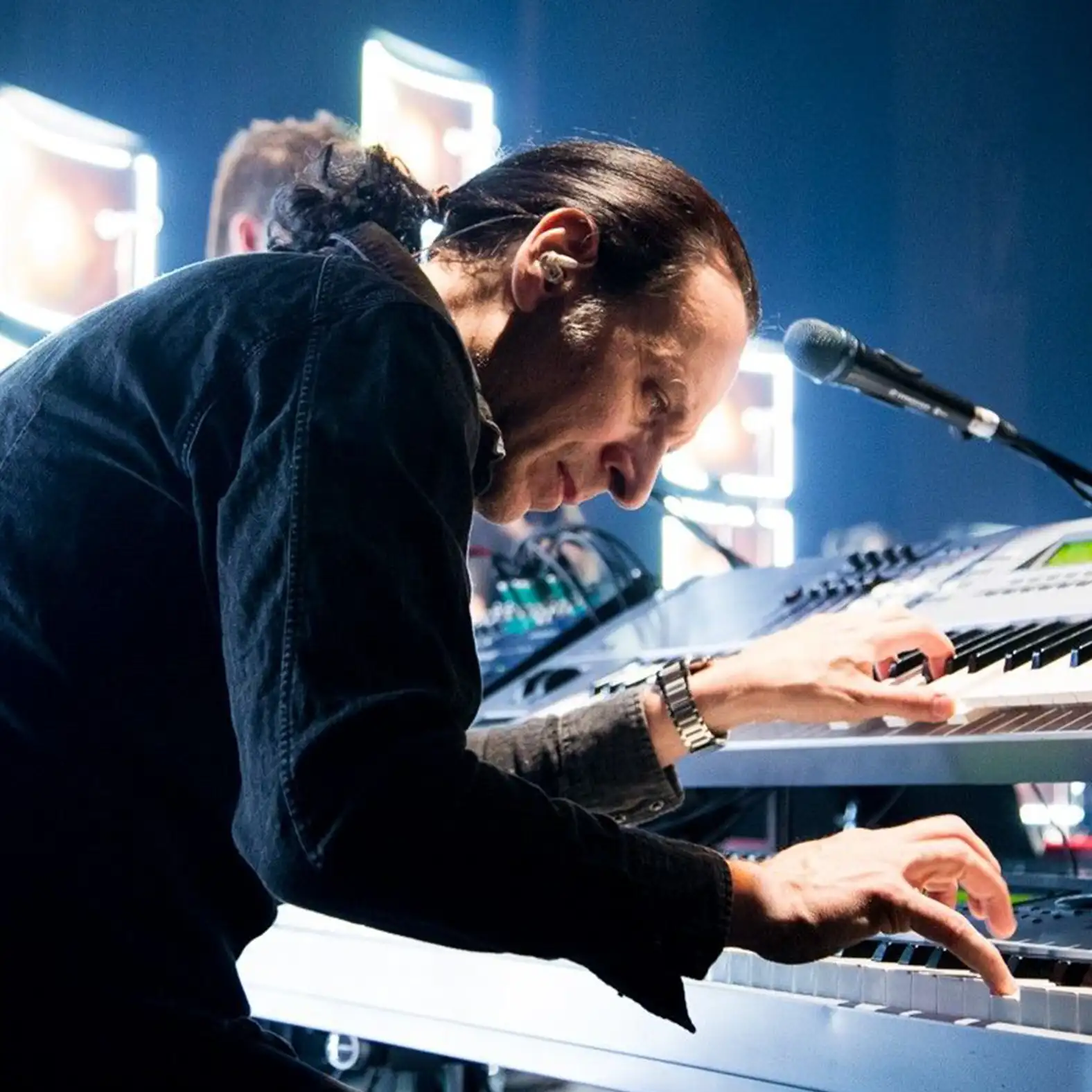
Head to Head with Paul Haslinger Although achieving success in the decidedly crowded field of film scoring is by no means a simple task, Paul Haslinger has since 1987, quietly been adding an ever expanding list of box office successes to his filmography. Though his name first came into the spotlight as a member of the electronic super group Tangerine Dream, it is his solo work for film and his ongoing partnership with Graeme Revel that has made him one of Hollywood's most active and in-demand composers.
|
|
|
AAS: How did you start doing music ? PH: By painting several keys of my family's upright piano with nail-polish, so I could remember them better (at age 5...). Neither my parents nor my older sisters thought it was very funny, but it worked great for me. How did you get involved in Tangerine Dream ? They were looking for a session player for their 86 UK tour and I was referred through a friend in Vienna. The concerts went well and we started working on 'Underwater Sunlight' in the studio right after the tour had finished, at which time I had become a fulltime member of the band. What was your role as a player/composer ? I came in right at the start of the Midi/Computer revolution. 'Atari' was king in Europe at the time, and I guess my initial role was definied somewhere between computer-kid and classically trained keyboard player. Over time I got more involved into all aspects of production, including filmscoring and recording/engineering.
What are the latest film projects you have been working on? At the end of July I finished the surf movie 'Blue Crush', directed by John Stockwell, which has just opened in theaters in the US. The score is a mix of electronic, orchestral and hip-hop elements. The Canadian film 'Picture Claire'(director Bruce McDonald) which I worked on last year, should finally get released this fall. When did you start making music with computers, and what was your setup then ? My very first sequencer was a Yamaha QX-1 which I still own (as well as my trusted Masterkeyboard at the time: a Roland MKB-300, which has travelled the world with me...) Right at the time when I joined TD, the Atari ST1040 became my main workhorse. In those days we got excited about 20MB Harddrives and 44MB Syquest removables :-) Software at the time: Steinberg Pro-24 and a load of sound editors for anything from DX7 to D50. Christopher Franke at the time had pretty much 'everything' in his studio, so while working with him there, I familiarized myself with the other (proto)-computer music systems of the time, most importantly the PPG Wave terminal. How do you se the future of electronic music? Well, it's definitely not a novelty anymore ... Yet it has become part of the musical fabric of our time. I see it dispersing even wider in the future, so aspects of electronic music will 'infiltrate' almost every kind of music production. On a technical level, I think we are on the bridge between 2-dimensional (sample-based) and 3-dimensional (model-based interactive) sound. Virtual instruments will naturally first replace Synth-modules (since they are easier to emulate) - but the ultimate goal is to create 'complexity in response' - and that will require a more powerful playback/response network (the instrument emulation itself), but ALSO a new kind of input device, which is able to distinguish and transfer very complex sets of data (like the Bosendorfer SE290). One more thought: the masters of classical music (Mozart, Beethoven, Schubert) were also masters of orchestration and sound. They knew how to 'produce' the desired effect within the limits of their ensemble and given space acoustics. Today, as artists, we have an incredible amount of options, but the same responsibility: to choose the right space, the right instrumentation, the right combination for what we are trying to achieve. And just as sheet music was the primary sounding board then, computermusic software is our main tool today. What are your next projects? More filmwork... some collaborations (Brian Williams, Lightwave) and eventually, another album. In your productions, where does the Lounge Lizard fit? I've been very frustrated for a long time with sample-based electric piano sounds. None of the sample CDs or presets out there even come close to a real Rhodes or Wurli. When I tried the Lizard I was immediately impressed with several things: a)
the way it responded to velocity (multi-parameter change) Now, for a good e-piano recording, one used to have to modify and amp/mic the session a certain way. The Lizard gives you these options (overdrive etc) 'on the instrument' - so one can develop, save and recall these 'complete sounds' according to song and session. Composition and Performance/Recording/Engineering used to be two different spheres. Thanks to instruments like the Lizard, they become one. What's your studio setup look like these days? Don't ask, don't tell ... Having played with lots of hardware, did you think that the music would evolve that much towards software? Yes, that was only a question of time. The dream of the modular studio slowly but surely is becoming a reality ... and the nightmare of inter-software-incompatibility is just starting :-)
| ||||||||