







FR | EN
In depth details of the components, signal flow, and modules composing Chromaphone.

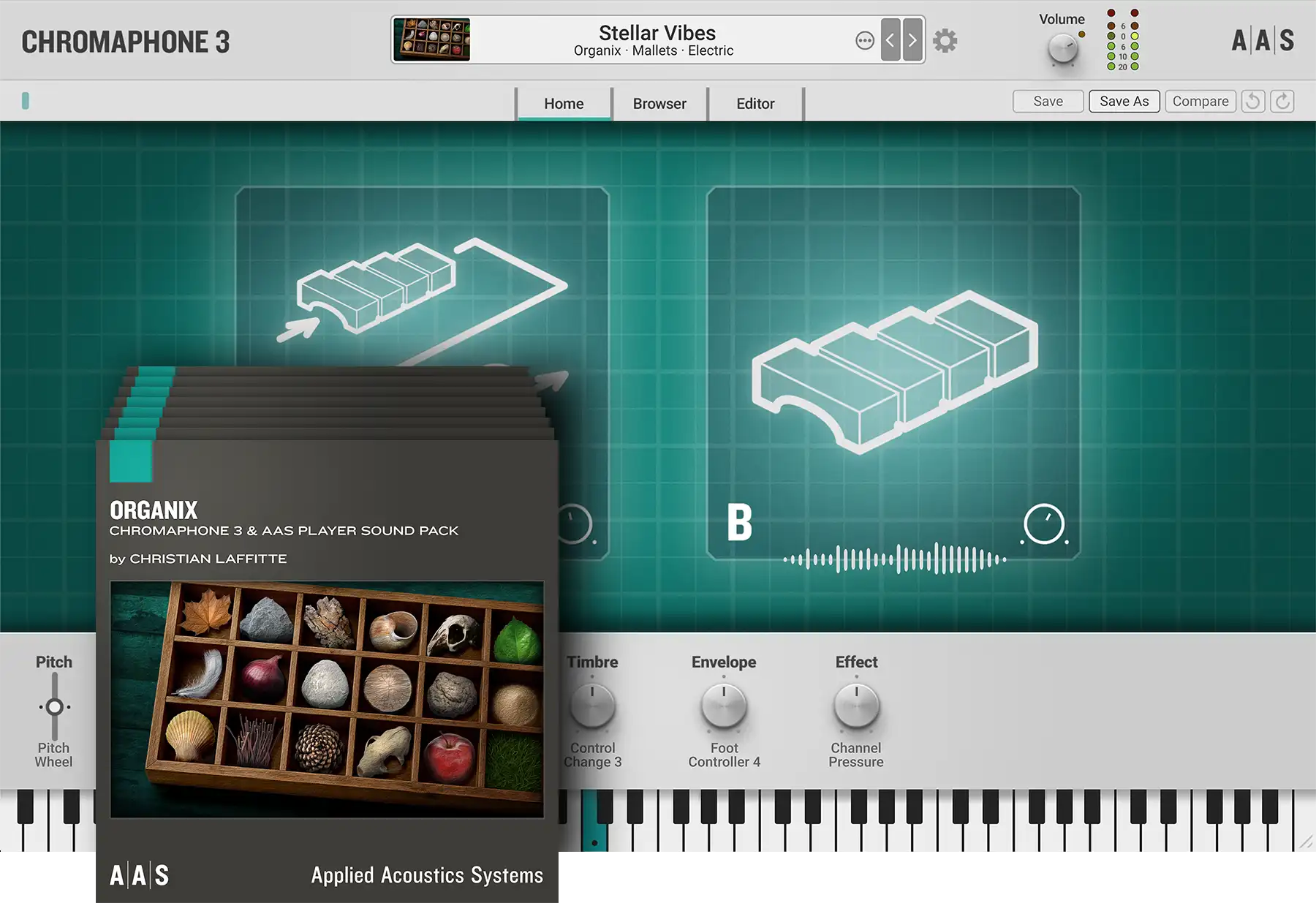
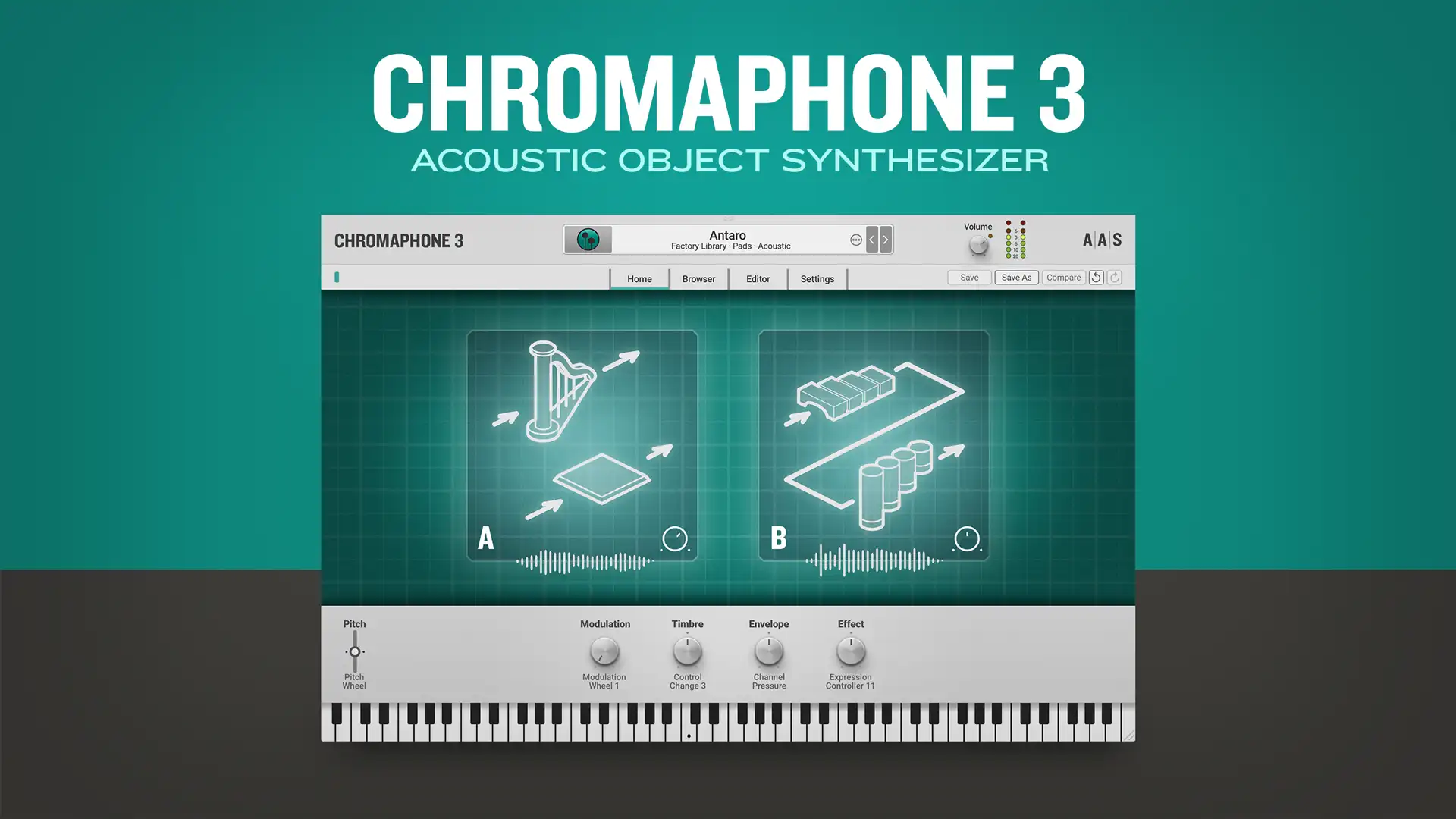
Chromaphone is an atelier for musicians and producers. At the turn of a few knobs, become an instrument maker, shaping metal, carving wood, and stretching skins. Craft and play expressive and responsive instruments that have a real-life presence.
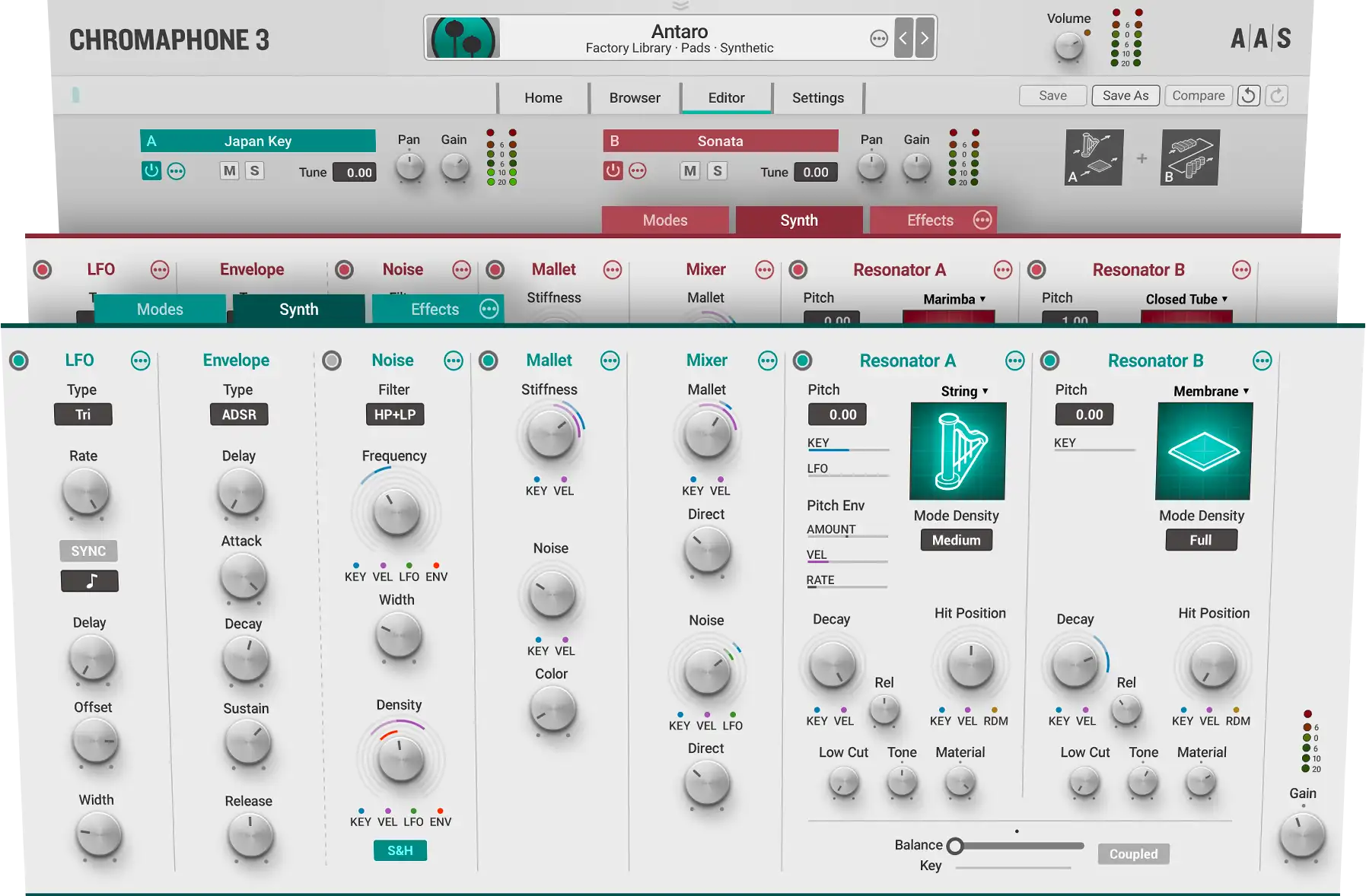
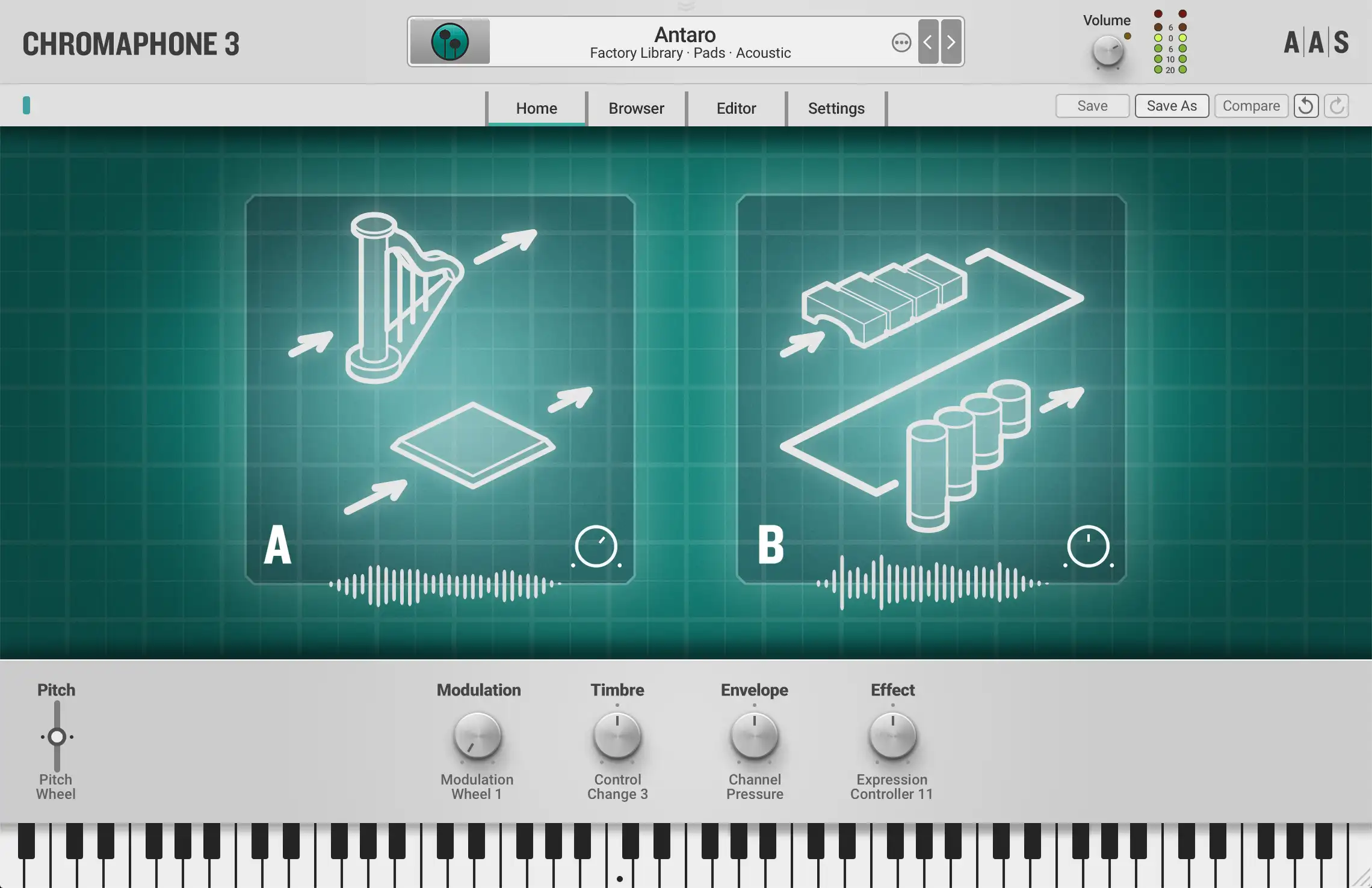
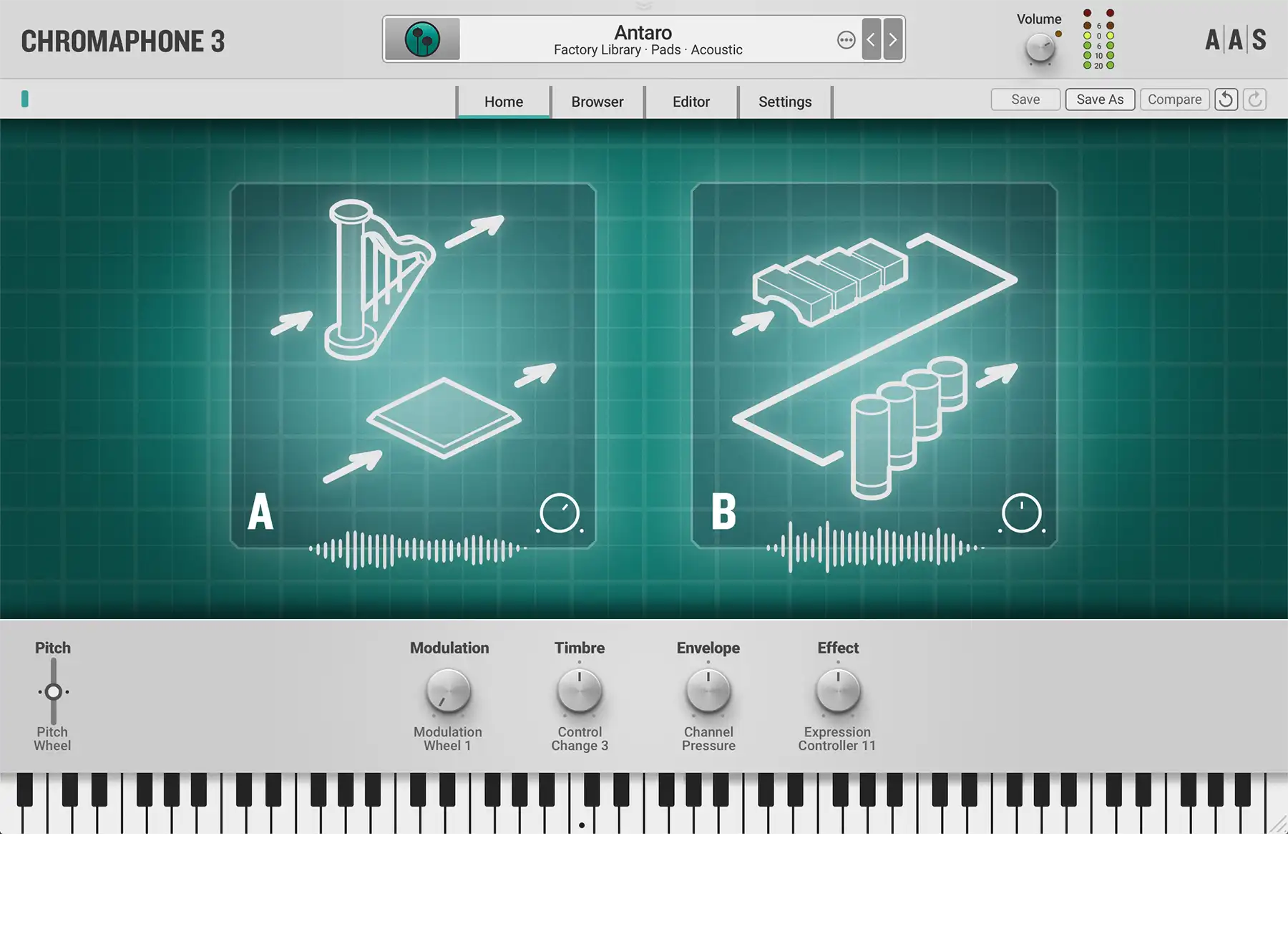
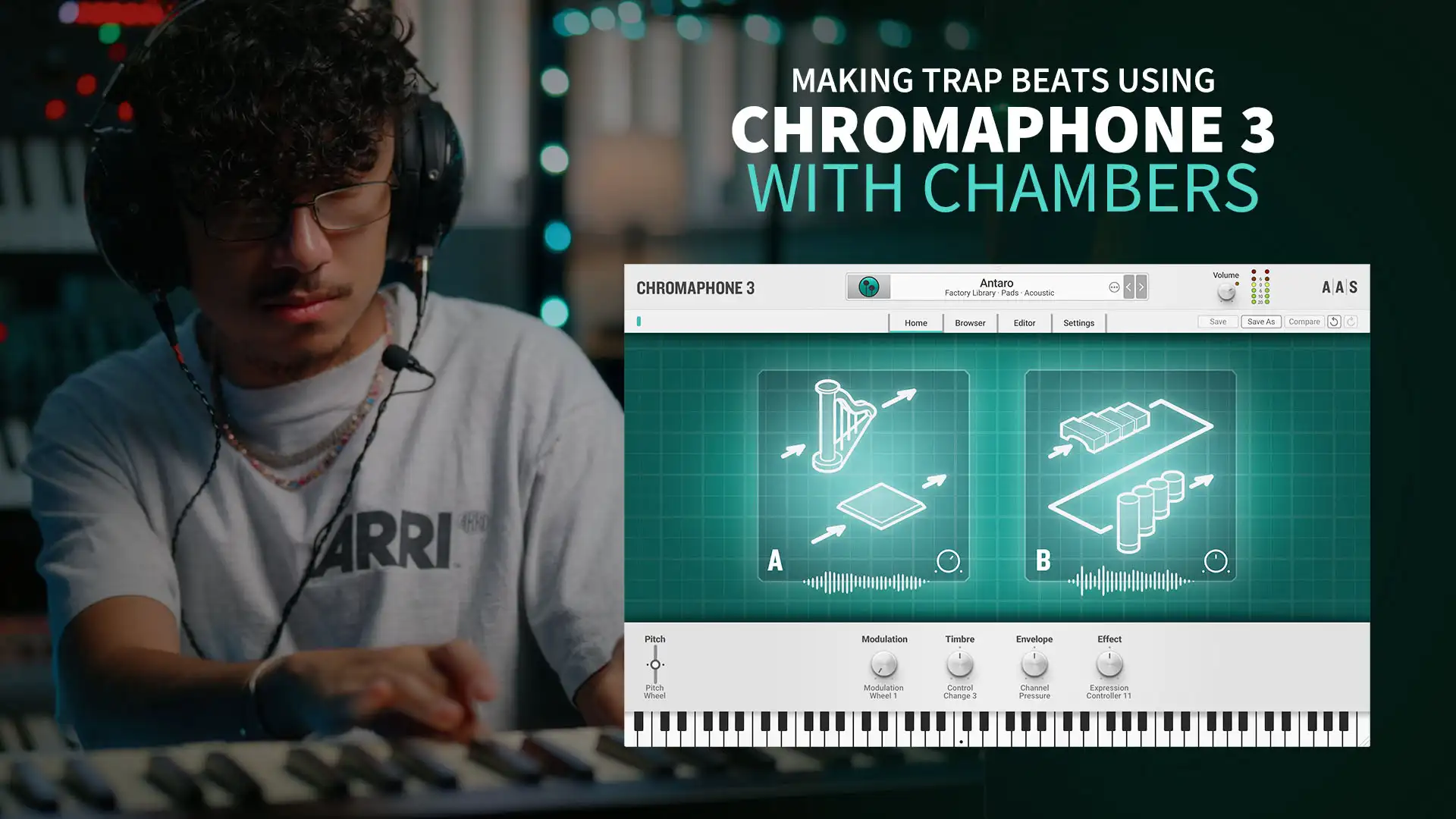
Chromaphone lets you create pairs of acoustic resonators from string, beam, marimba, plate, membrane as well as open and closed tube objects. There is also a manual mode that let you pick your own partials for super specific applications. The Material, Tone, and Decay controls—which together shape the actual tone of the resonators by working on the amplitude and decay of the partials—yield a rich palette of sonorities. With just a few parameter tweaks, go from wood to metal to glass and completely change the nature of the instrument you are crafting.
The Pitch control is used to adjust the reference pitch and relative size of the object. The Pitch's Key (keyboard) modulation can be tempered for an exact match of the keyboard note; fixed for a soundboard or one-shot construction; or stretched and contracted for interesting effects.
The Hit Pt (Hit Point) control determines where the impact signal from the Mallet and Noise modules strikes on the resonator. It has a great influence on the tone and also mimics live playing techniques and articulations.
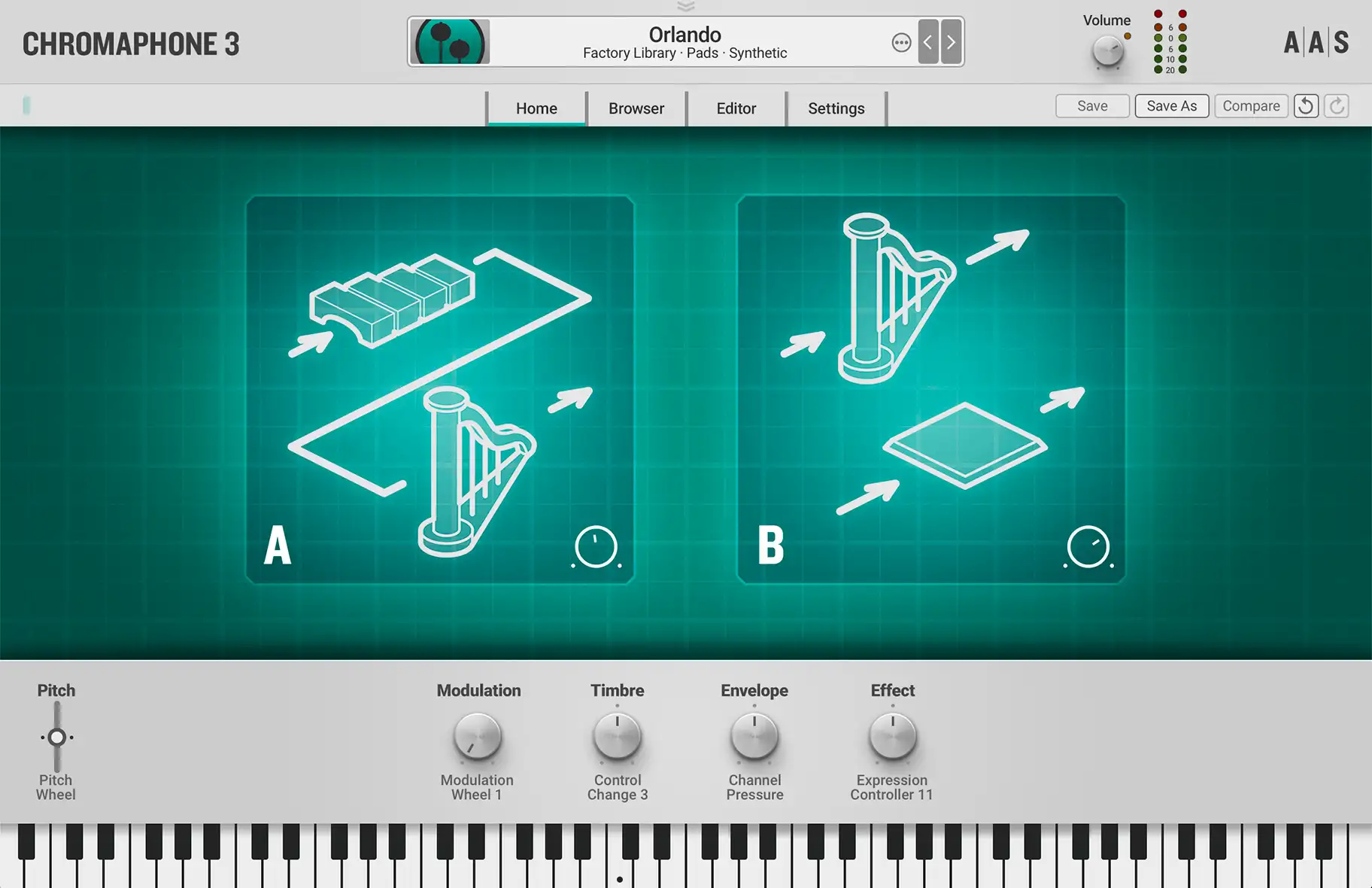
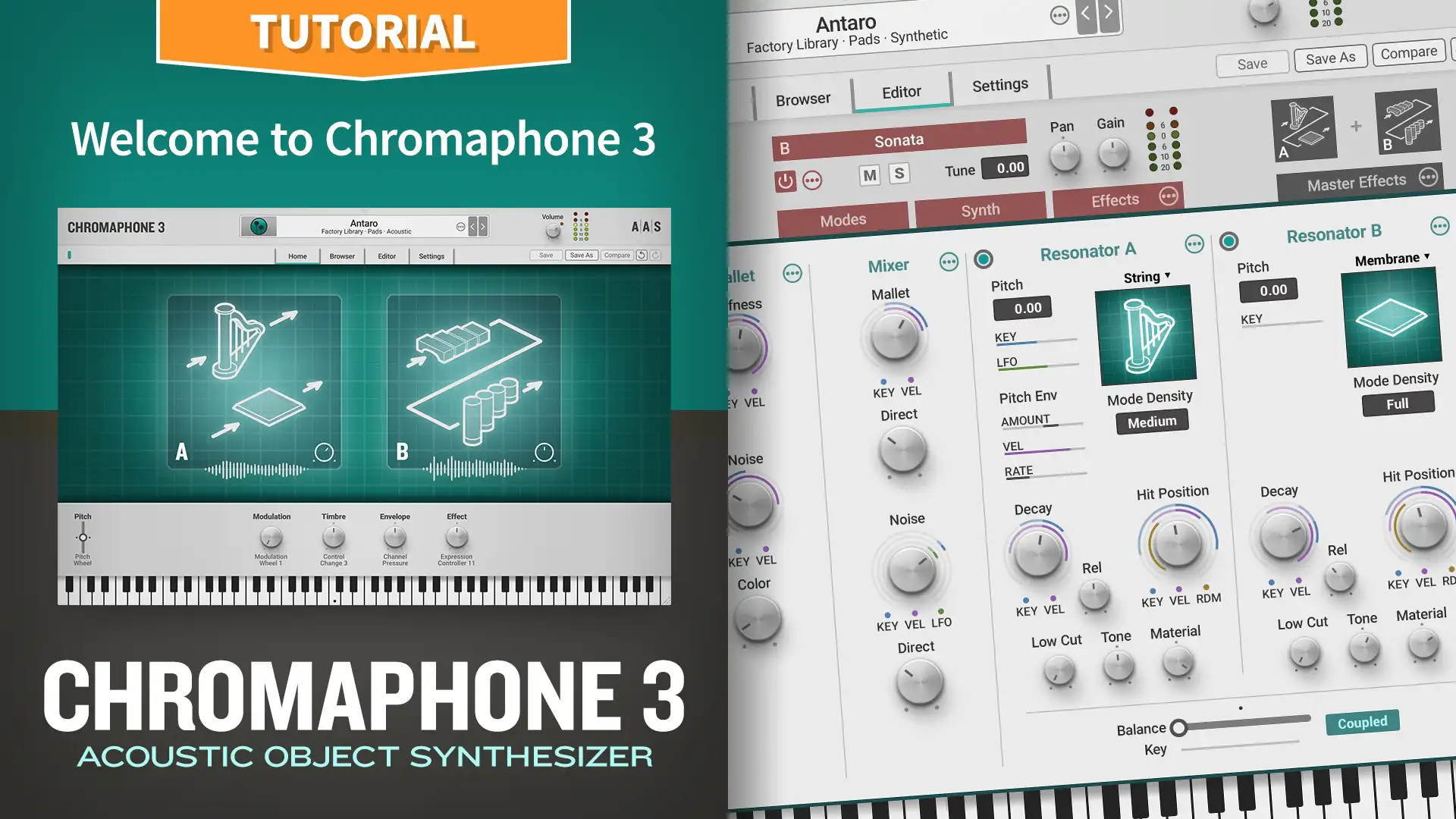
Chromaphone follows a simple signal flow diagram where an excitation signal from a Mallet and Noise module is fed to a pair of resonators. The resulting signal is then sent to two multi-effect modules for extra sound shaping possibilities.
The heart of the synthesizer lies in the resonator pair which can be configured in parallel or in coupling mode to emulate different types of instruments.
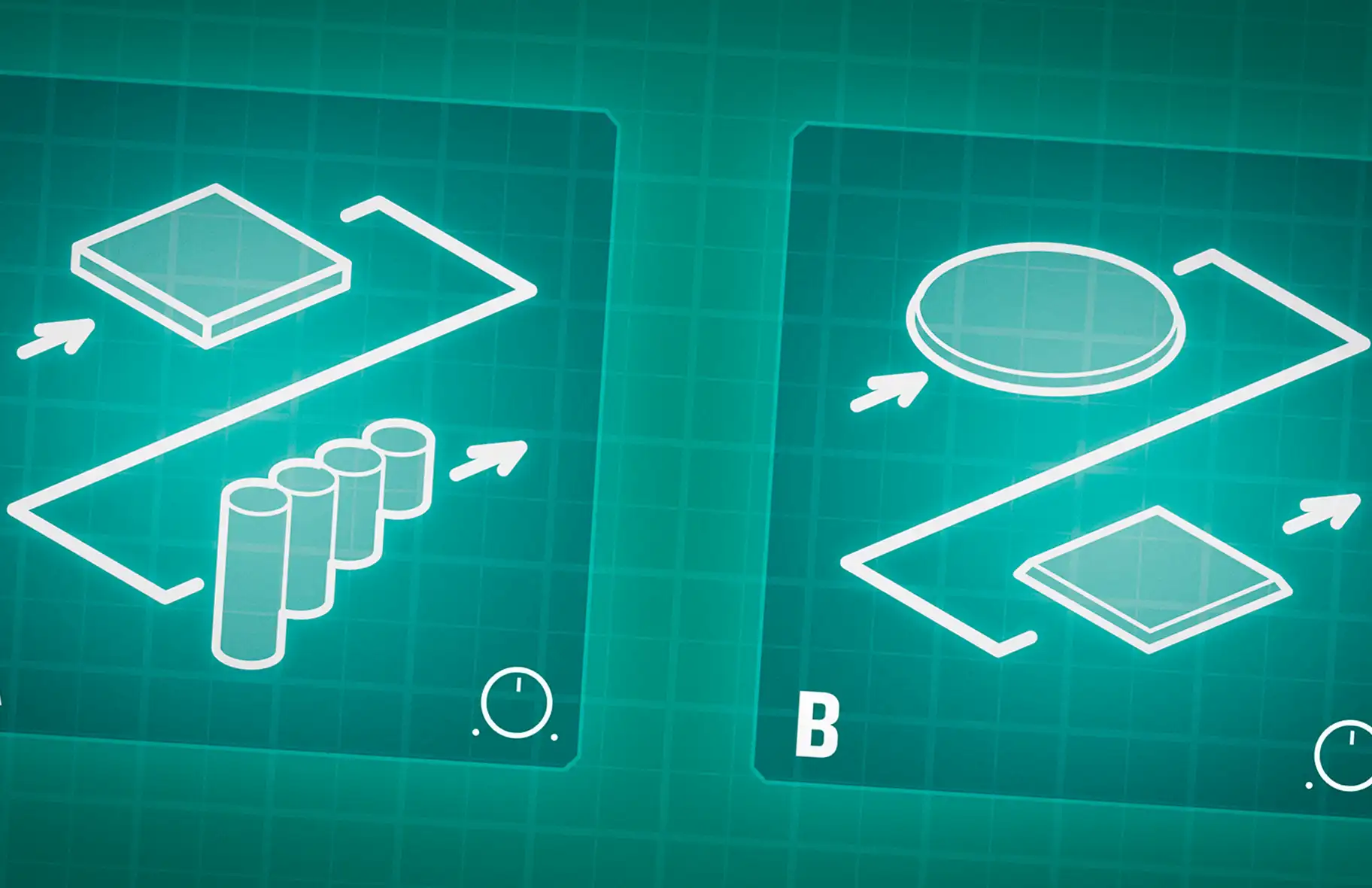
In parallel mode, each resonator receives the mixed signal from the Mallet and Noise modules. The resulting sound is a simple mix of both resonators as if they were played at once.
In coupling mode, the resonators are laid out in series. It's the first resonator that receives the mixed signal of the Mallet and Noise modules. The connection between both resonators is bi-directional and deals with energy information rather than an audio signal. That's where the magic happens: depending on each resonator's characteristics and where they are physically connected (second resonator's Hit Pt parameter), they interact dynamically to form a totally new object!
The Mallet module provides the triggering impact. The Volume and Stiffness controls craft different type of sticks, mallets, and beaters, while the Noise parameter brings texture to the hit. All can be modulated by keyboard velocity and pitch to provide great playing dynamics. A typical modulation scenario would tie high velocity hits to a stronger impact volume as well as softening the mallet to emulate the non-linearity found with piano hammer head felt.
The Noise module either flies solo or complements the Mallet module with a complex blend of entropy. Its associated envelope generator and filters can provide tailored excitation signals very different from the Mallet impacts.
Noteworthy of the noise team is the Density parameter which controls the rate at which random samples are fired by the module. Its range spans from a barely registering Geiger counter (a type of radiation detector) to a continuous full blast of white noise.
Loud or quiet, bursting or evolving, dense or porous, broadband or filtered, this noise source is the key to unusual and creative effects.
Chromaphone is based on a brand-new technology that allows one to couple objects together, in other words to precisely model the interaction between objects as opposed to simply feeding the signal from one object to the other. This interaction between components results into a new objects which, while being related to its original components, behaves and sounds differently. In real life, percussion and string instruments are based on combinations of interacting objects such as a string and a soundboard for a guitar, a bar and a tube in the case of a vibraphone or a skin and a column of air in a drum. This coupling modelling technology captures key acoustic behaviours resulting in instruments that have a real-life presence.
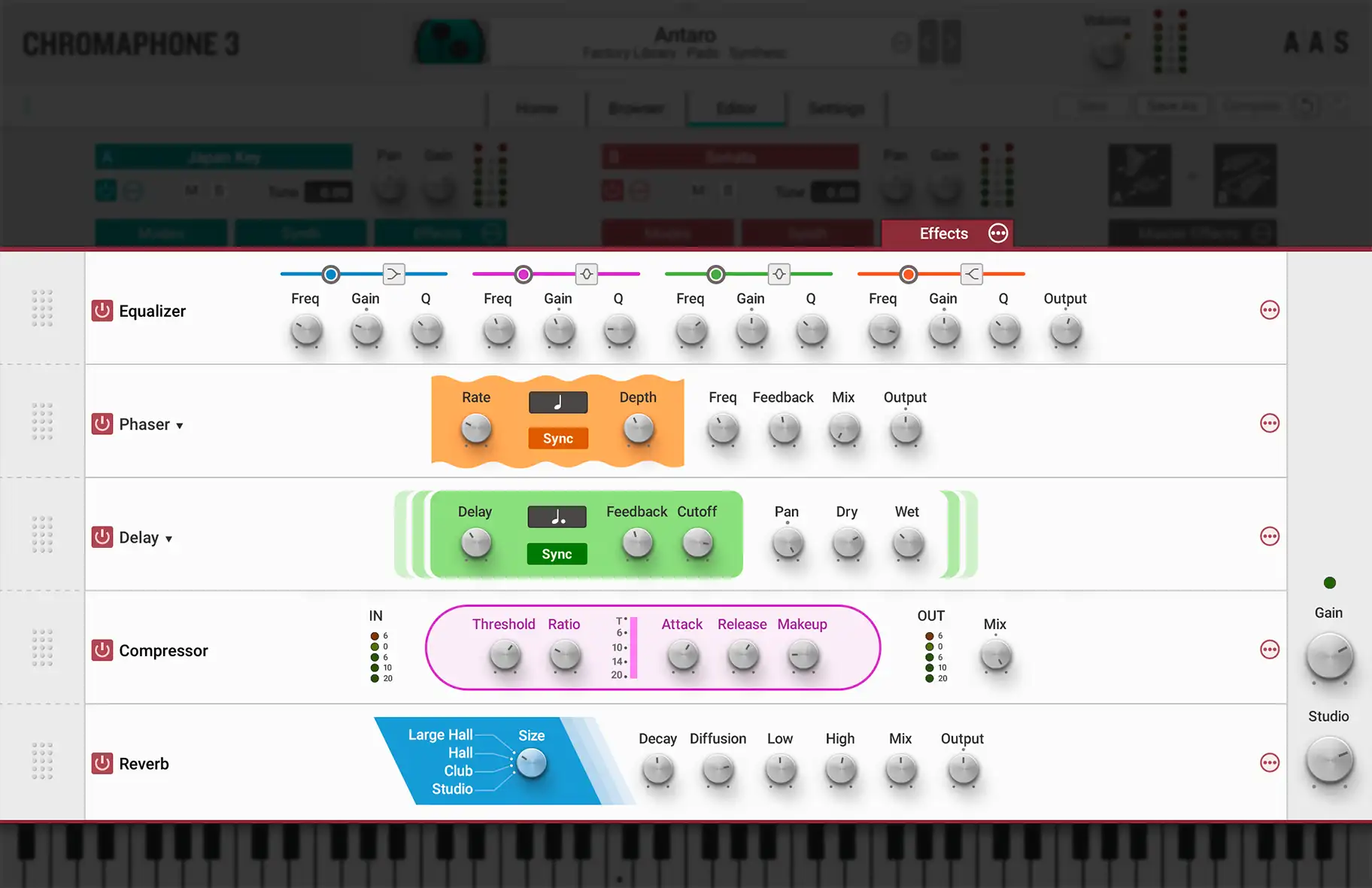
At the end of the Chromaphone signal path are two multi-effect modules in series allowing you to further shape the sound from the resonators. Each module includes three different types of delays (ping pong, digital and tape), a chorus (mono and stereo), a flanger, a phaser, an auto wah, a wah wah, a notch filter, a 3-band equalizer, a tremolo, three different types distortion, and reverbs.