Akufen

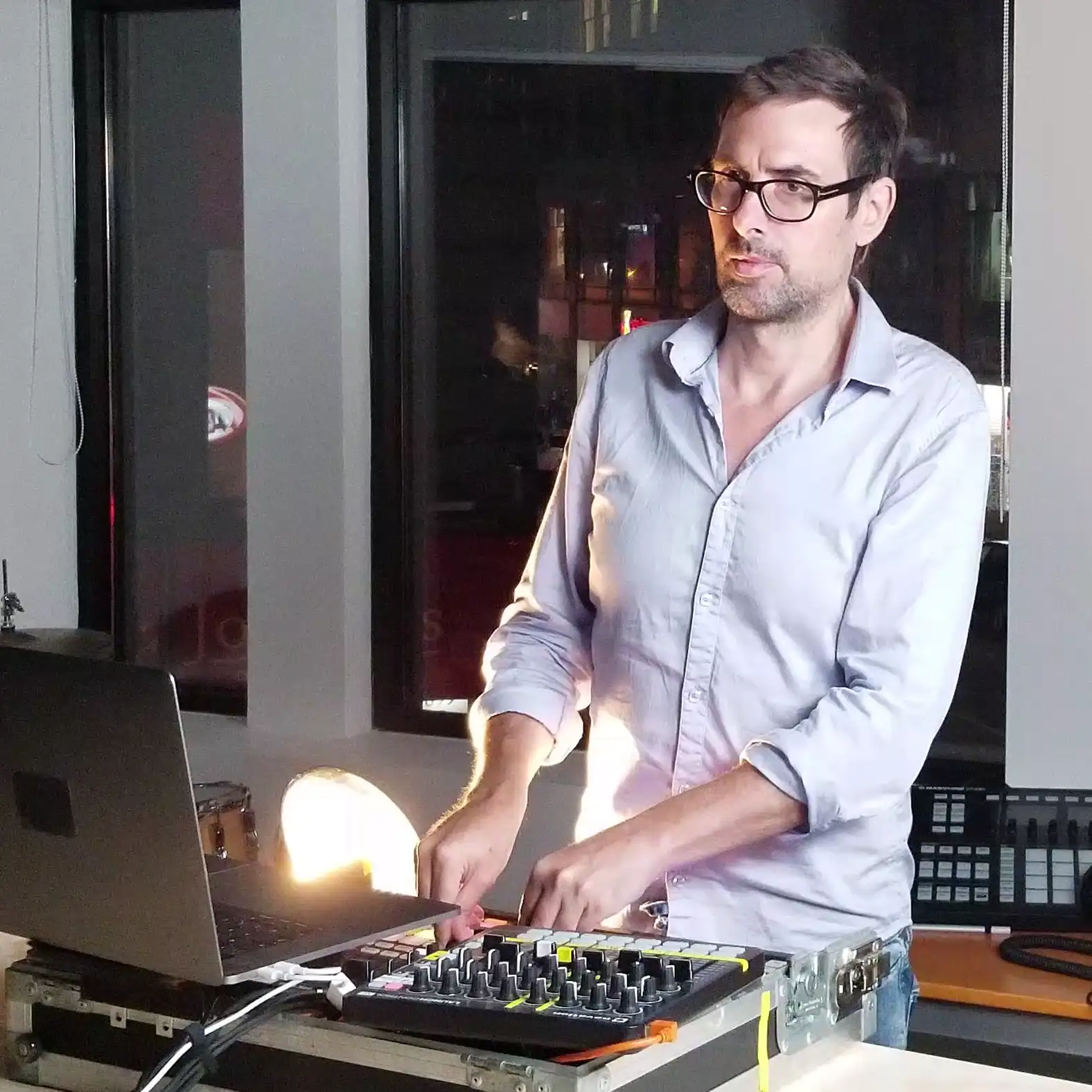
Akufen, also known as Marc Leclair, produces an interesting mix of minimal house and experimental techno with underlying influences from Stockhausen, Steve Reich, Kraftwerk, and Throbbing Gristle.

    At the basis of his 2002 first full-length album My Way (Force Inc.), Marc collected hours of audio material from AM/FM and shortwave programs that he fragmented into minute voices, blips, and other unrecognizable bits that were then applied to catchy, dance floor friendly house tracks.

    In 2005 Marc Leclair returns under its own name with the release of Musique pour 3 femmes enceintes (Mutek) and proves that he had more than one card up in his sleeve. With the skillful integration of instrumental tones and outer-space noises, he built extended and dreamlike pieces that defy time.

    Throughout the years, Marc has also released numerous tracks for labels like Force Inc., Background, Traum, Oral, Trapez, and Perlon under the Akufen, Anna Kaufun, and Nekufa monikers.

A Few Words with Akufen

Maybe you could start by telling us a bit about your background, how did you get into making music?

Well, to make a short story, I've got an interest in music at a very early age, I was a very musical kid as far as I can remember. But I really got into playing around the age of six when I've started tweaking the knobs of a cheap organ we had at home in our basement. I also played the harmonica and the guitar as I got a little older and formed a few bands with school mates. Together we've played at college parties and in our basements every weekend for our friends.

    After trying various band combinations I've came to the sad conclusion that I wasn't just made to deal with other musicians. Around the same time I've discovered more experimental and contemporary composers such as Steve Reich and Stockhausen. Also bands like Kraftwerk and Throbbing Gristles got my attention and I knew from that day that I wanted to do things differently no matter what the cost was.

    I then started to experiment with tape loop-cutting, a Roland SH-7, a Roland sequencer, and a four-track recorder. Later on, around the age of 16, I left my parental home to move on and went live downtown Montreal in order to meet other musicians who shared the same ambition and forward thinking on music.

    Years went by and I've collaborated on a few experimental bands line-up Like Atomic Kitchen Gravity with two of my good friends Jean-François Charette and Christian Miron. At the time we were very much into acts such as The Residents, Cabaret Voltaire, and Telex & Psychich TV. I was playing the guitar and was programming sequences on an Atari ST1040 using also a Casio FZ-1 sampler.

    Then came the big acid house and UK dance revolution of the late 80's. Cities like Detroit, Chicago, and London were taking over the remains of the late industrial empire.

What projects have you been working on recently?

I believe the last project to date was my last album on Mutek records, Musique pour 3 femmes enceintes which got me invited to play at ARS ELECTRONICA in Linz this year. But I work on a daily basis on the new Akufen album, this is probably my main preoccupation at the very moment. I'd love to spend more time working on developing my record label Musique Risquée and recruit new interesting musicians, which is why I've decided to stay off the road after November. I've been on the road quite a lot and spent most of my studio time on remixes which made it hard for me to work on new material.

Which tools do you use to create your music?

A Toshiba Satellite Pro laptop with Fruity Loops, Sound Forge, Acid, and Cool Edit Pro. A Mac G4 Powerbook with Reaktor, Tassman, Lounge Lizard, Ultra Analog, Peak, and Live. My board is an automated Yamaha Pro-mix 01. A pair of referential Yamaha NS-10m monitors powered by a Bryston 3B-ST amplifier. An Elektron Machinedrum. A Nordlead 2 keyboard. A Doepfer modular mini-system and vocoder. An MC-202. A Fender Telecaster. A Cry Baby and an Electro-Harmonix Double-Muff pedals. My faithfull DX-7. Three short-wave radios and two tuners: one tube Marantz and one Kenwood. A cheap Audio-Technica microphone for field recording. That's basically it!

You've been known for recycling sounds from many different sources—how do you integrate software synthesizers in your music-making process, do you have the same recycling approach?

Well, the synthesizers really become handy when I feel like playing a melodic part or I need to create a backbone percussive structure of a piece. I try not to overuse software synthesizers because I think they are way too easy to trace. I will as much as possible try to blur the evidences of the use of a synthesizer as I want my music to be as vague as possible in terms of how it was made. The best music to me is the one you cannot identify, when the musician has a language you cannot decode. I prefer way more to recycle sound matter from everywhere, TV, radio, answering machine, and field recording. There are countless sound possibilities within one square foot of your flat. It's like becoming a kid again. You bang on everything, you scream, you fart—it's fun.

What do you consider to be the most challenging aspect of music-making?

Reinventing yourself most probably. That is a tough one. But you have to do it otherwise you become a pale copy of yourself and the formula gets boring. You have to constantly surprise yourself and then the others. But if you want to pursue a life long career you can't serve the same dish every meal.

Finally, what's coming up next for you?

God I wish I knew. That's what keeps me going I guess. Not knowing where I am going. Even if I get bored someday and that I feel like giving up, I'm too curious to find out what music I'll be making in ten years from now. That's the beauty of being an artist; You never know who you really are and where it will take you. For now I just need to stay home for a while and simply write music and spend some time with my girlfriend and our daughter. That is my main thought for now.

Thanks Marc!